Hardware encryption: the fundamental difference
When we talk about an "encrypted phone", we don't mean a phone with an encryption app installed. We mean a device whose entire operating system was built from the ground up with security as the priority. The difference starts in the hardware: the devices we offer at Securfy use hardware-level encryption —the same AES-256 standard used by governments and financial institutions— built into the processor, not bolted on as a software layer that can be bypassed.
A standard iPhone or Samsung Galaxy also encrypts its data, but with keys the manufacturer can —and in some cases must— hand over to the authorities. On a device encrypted with GrapheneOS, the encryption keys are generated on the device and never leave the hardware. Not even the chip manufacturer can reach your data without your password. It's the difference between holding the only key and holding a key the locksmith kept a copy of.
Protection against physical access
Encryption at rest protects your data if someone steals your phone, but the protection goes much further. A genuinely encrypted device implements hardened authentication: the unlock password is verified against a hardware security module (Titan M2 on Pixels, Secure Enclave on iPhones), not against the operating system. This stops brute-force attacks because the chip physically limits the number of attempts.
GrapheneOS adds another layer: auto-reboot mode. If it detects physical tampering —the case being opened, or forensic tools connected over the USB port— the system can be configured to power the device down, wipe the encryption keys from memory and require the full password (not a fingerprint or face) to unlock again.
Regular phones, by contrast, have an accessible recovery mode that allows firmware flashing, data extraction or even a device reset. On a properly encrypted device, the bootloader is locked with integrity verification, and any attempt to modify the system makes the device refuse to boot without the correct key.
Is a regular iPhone enough?
Apple has done excellent work marketing privacy, and the iPhone is objectively more encrypted than most stock Android phones. But it has serious limits. First, you can't verify what the operating system does: iOS is closed source, and you trust what Apple says about how it works. GrapheneOS is fully open and independently audited by security researchers worldwide.
Second, Apple collects enormous amounts of telemetry. Every time you unlock your iPhone, every app you open, every search you run: all of it generates data Apple processes on its servers. You can limit some of this telemetry in the settings, but you can't remove it completely. A Pixel running GrapheneOS sends telemetry to nobody, because the code that would do it has been stripped out of the system.
Third, the iOS app ecosystem is governed by Apple. If Apple decides tomorrow that certain privacy or encryption apps don't meet its guidelines, it pulls them from the App Store and you can't install them. On Android, sideloading is a user right, not a revocable privilege.
The point-by-point comparison
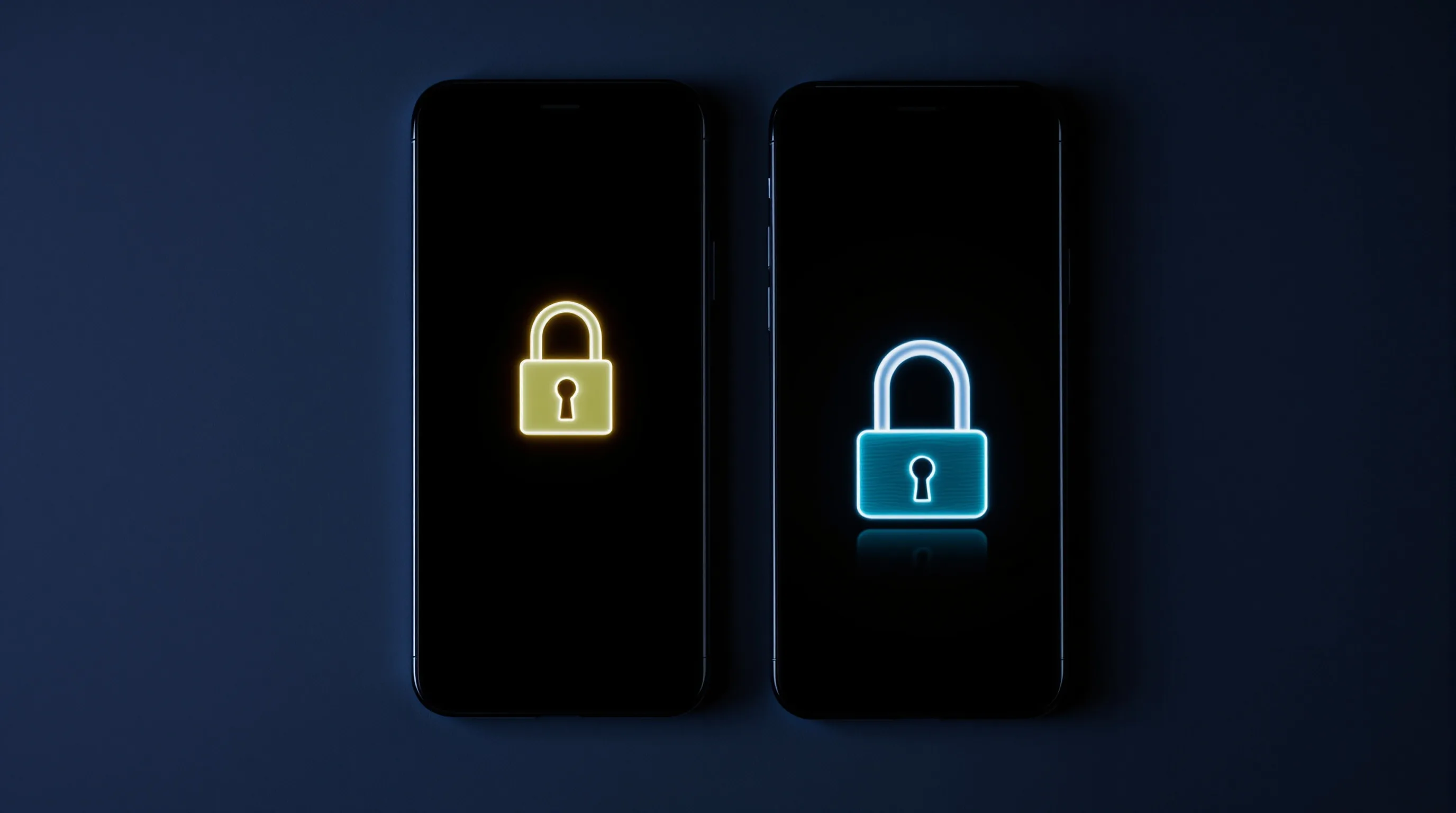
If you had both devices in front of you, these are the differences you could verify one by one:
- Encryption keys: on a regular phone, the manufacturer may retain access mechanisms; on an encrypted one, keys are generated inside the device's security chip and never leave it.
- Telemetry: stock Android contacts Google servers hundreds of times a day; GrapheneOS sends nothing, because the code that would do it does not exist in the system.
- Unlock attempts: a regular phone trusts software to limit attempts; an encrypted one enforces the limit physically in the chip (Titan M2), and can wipe itself after repeated failures.
- USB port: open by default versus locked while the screen is off — the favourite entry point for forensic extraction tools.
- Permissions: on a regular phone you either accept or skip the app; on an encrypted one you can feed apps false data (coarse location, an empty contact list) without them knowing.
- Updates: dependent on manufacturer and carrier versus shipped directly by the project within days.
- Boot: a regular phone can boot into recovery and be reflashed; an encrypted one verifies the integrity of the whole system on every boot and refuses to start if anything was modified.
What an encrypted phone does NOT do
Being honest about the limits is part of security. An encrypted phone does not make you anonymous: your SIM card still identifies you to the carrier, and cell towers log your movements. Other measures exist for that (prepaid eSIMs, VPNs, not linking personal accounts) — a good setup covers them, but the hardware alone does not solve it.
It also cannot protect what you choose to publish or hand to third-party services: upload a photo to a social network and the social network has it. And it does not stop phishing or social engineering — no hardware protects you from a malicious link you decide to trust. What it does guarantee is that whatever lives inside the device only leaves it when you decide: that is its job, and it does it verifiably.
How much does an encrypted phone cost?
Less than the word "encrypted" suggests. Because the hardware is a stock Google Pixel or iPhone — what changes is the system and the configuration — the price starts at the real cost of the device: at Securfy, an encrypted Pixel 9a starts at €650, and flagship models reach €1,800. Every device ships individually configured, with encrypted communication apps installed, usage training included and a 2-year warranty.
Be wary of four-figure "encrypted phones" that are an old Android with an encryption app on top: the story of Encrochat and Sky ECC shows how that model ends. A device whose security depends on the vendor's central server falls entirely when that server falls. With GrapheneOS, the security lives on your device and in openly auditable code — there is no central server to compromise. You can browse the full catalogue in our encrypted phone store.
When you need an encrypted device
Not everyone needs the level of protection an encrypted phone running GrapheneOS provides. But if you recognise yourself in any of these profiles, the investment is worth every cent:
Professionals handling sensitive data: lawyers, journalists, doctors, psychologists. Your clients trust you with information that could ruin lives if it leaked. An encrypted device is an extension of your professional duty of confidentiality. In many countries, data protection law makes you personally liable for security breaches.
Executives and business owners: corporate information —strategies, contracts, patents, negotiations— is worth a fortune to competitors and malicious actors. Industrial espionage is a multi-million-euro industry running on surprisingly accessible tools.
People at personal risk: harassment victims, people in contentious divorces, activists, political dissidents. For these profiles, a regular phone can be a literal danger. An encrypted device hands them back control over their most intimate information.
Citizens who care about privacy: you don't have to be at risk to value your right to a private life. Mass surveillance and the personal data economy are documented realities. An encrypted phone is the most effective tool for deciding what information you share, and with whom.